
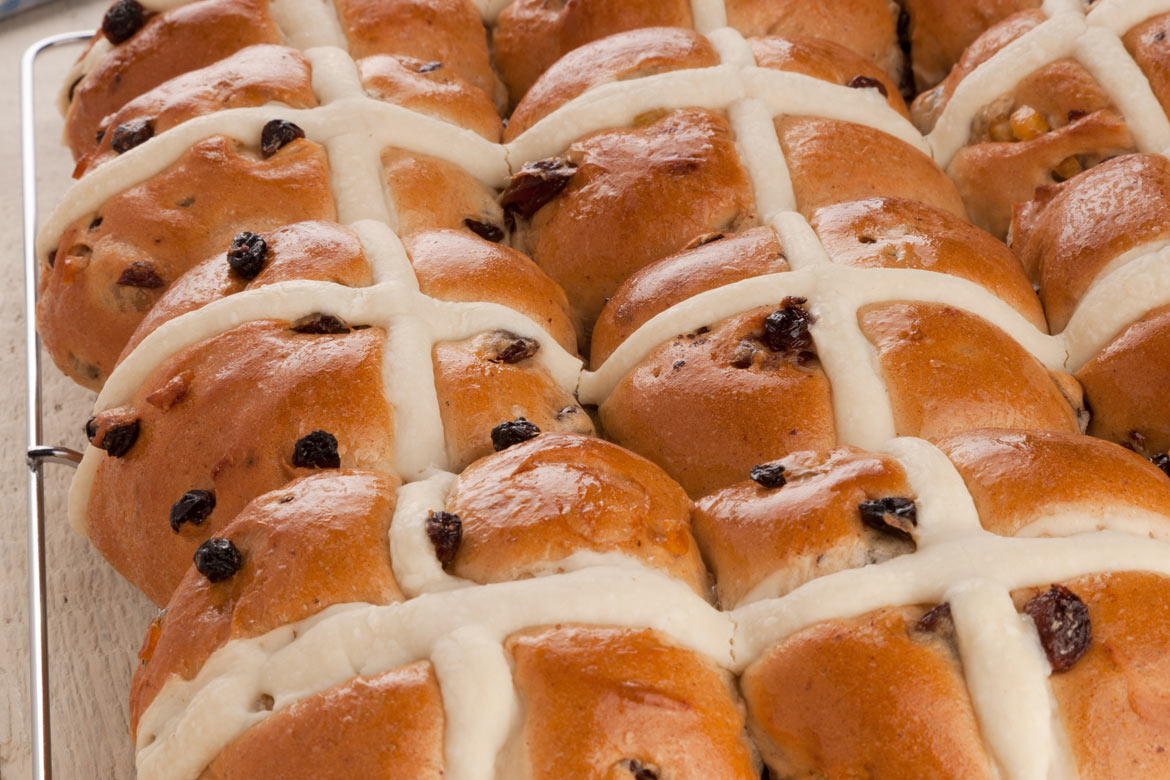
Easter time in England is a time for chocolate eggs, roast lamb or ham, and Easter egg hunts after the Easter bunny has visited! One food that everyone loves around Easter, including myself, is the hot cross buns. I remember having these as an Easter treat when I still lived at home with my parents but at the time I was not aware of the tradition so was fun to find out more!
According to Wikipedia the name for the Hot Cross Bun was commonly known as Good Friday Buns for nearly a hundred years and associated with the end of Lent. Then during the 1730’s the buns were sold on the streets, and it was then that the popular rhyme was created and the sellers would shout out ”One-a-penny, two-a-penny, hot-cross buns “………..a penny for a larger bun or for two smaller ones. This popular rhyme is now used as an English nursery rhyme.
Here are some of the myths, legends and superstitions that surround the hot cross bun:
- Share a hot cross bun with a friend to ensure a strong friendship and bond for the following year.
- The origins of hot cross buns may go back as far as the 12th century. Apparently, an Anglican monk baked the buns and marked them with a cross in honour of Good Friday. Over time they gained popularity, and eventually became a symbol of Easter weekend.
- Towards the end of the 16th century, Queen Elizabeth I passed a law limiting the sale of sweet buns to funerals, Christmas, and the Friday before Easter. The English were deeply superstitious, and believed the buns carried medicinal or magical properties, and were fearful of those powers being abused. Some even believed that buns baked on Good Friday would never go stale.
- To get around this problem, more and more people began baking the sweet buns at home.
- Hanging a hot cross bun in your kitchen is supposed to protect you from evil spirits, and to also prevent fires in the kitchen.
 Hot cross buns used to be available only around Easter, but today you can find them all year round. They are a spiced sweet sticky glazed bun made with currants or raisins decorated with a pastry cross on the top which represents the crucifixion of Jesus and the spices used signify what they put on Jesus’ body at his burial.
They can be eaten on their own, sliced with some butter on, or toasted with butter or jam. My favourite is toasted and topped with apricot jam! They make a lovely breakfast or snack and you can buy mini or regular sizes. I have heard of other flavours being added to the hot cross bun, such as chocolate, orange, coffee, apple and cinnamon, but I don’t fancy any of these as they would spoil it for me.
You can either make the buns at home by hand or using a bread machine, or here in Prague, you can buy them at Marks and Spencer and they can be put in the freezer for another day! 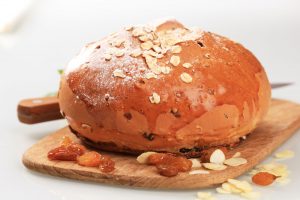
There is really nothing else like the hot cross bun, however, the “mazanec” (see image on right) bread here in the Czech Republic, is a similar sweet bread that is also eaten at Easter.
Hot Cross Buns Nursery Rhyme
Hot cross buns!
Hot cross buns!
one a penny, two a penny,
Hot cross buns!If you have no daughters,
give them to your sons.
One a penny two a penny,
Hot cross buns!


