
“Women’s lives, by no means spectacular, banal, in fact, say as much about politics as no end of theoretical political analysis. I sat in their kitchens – because that was always the warmest room in their poorly heated apartments – listening to their life stories, cooking with them, drinking coffee when they had any, talking about their children and their men, about how they hoped to buy a new refrigerator or a new stove or a new car.”
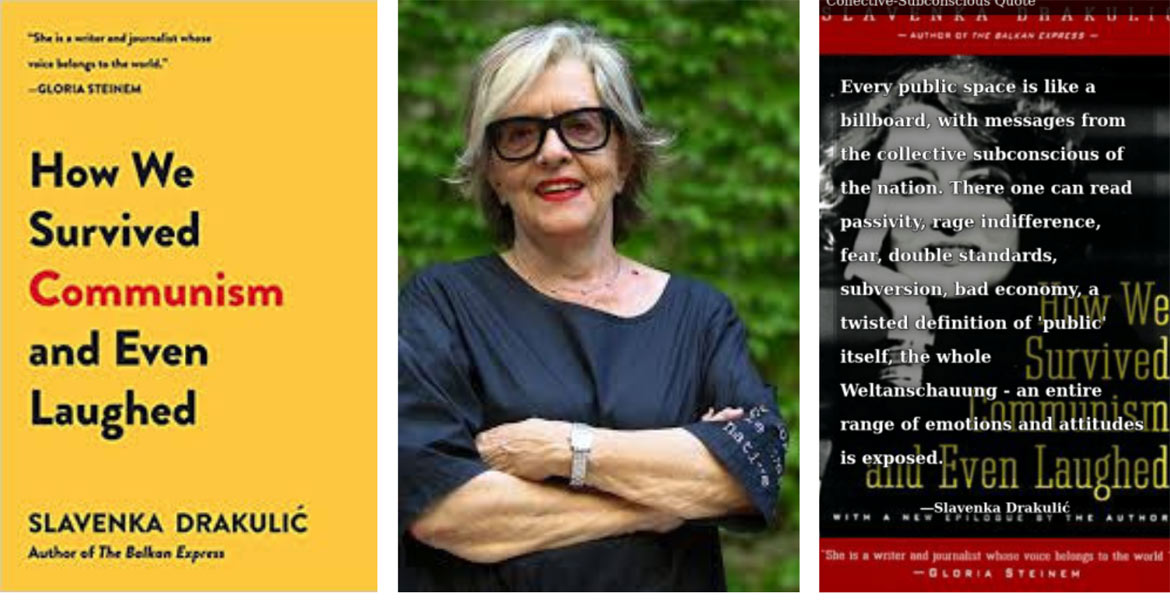
How We Survived Communism and Even Laughed is Slavenka Drakulić’s first-hand account of women’s lives in the Eastern European countries immediately after the fall of Communism. Published in 1992, this nonfiction collection of essays explores the intimate details of daily life as women struggled to adjust to the end of an ideology that had so deeply shaped, not only their political, but their social, economic and even their personal values.
Born in Rijeka, Croatia (the former Yugoslavia) in 1949, Drakulić is an internationally acclaimed journalist, novelist, and essayist whose works have been translated in many languages. She received a degree in Comparative Literature and Sociology from the University of Zagreb in 1976. In her writing, Drakulić addresses such themes as the political and ideological situation in post-Communist countries, war crimes, nationalism, feminist issues, illness and the female body.
Drakulić is a contributing editor at The Nation (USA) and her works have appeared in The New Republic and The NYT Magazine as well as international publications in Germany, Italy, Sweden and the UK. In 2004, she received the Leipzig Book Fair “Award for European Understanding.” In 2010, in Prague, she was named one of the most influential European writers of our time.
The book opens with Drakulić aboard a plane leaving her homeland on the day after Slovenia and Croatia seceded from the former Yugoslavia. In her opening essay, “The Trivial is Political,” Drakulić writes, “Growing up in Eastern Europe you learn very young that politics is not an abstract concept, but a powerful force influencing people’s everyday lives.”
In subsequent essays, Drakulić shares stories about eating soup and drinking coffee in crowded kitchens, discussing make-up (purchased by bribery, waiting in long lines or sacrificing a month’s wages), hair dye (there was only one color) and tampons (disposable sanitary products were impossible to obtain). In intimate and often heart-wrenching stories, she explains how the allure of owning a fur coat for an Eastern European woman wins out against animal rights propaganda or how “collecting” bottles, newspapers and rubber bands is born not for ecological reasons, but of a consistent fear of shortages.
Drakulić reflects on how the overnight changes of power that occurred between 1989 and 1991, does not automatically bring changes – basic food is still scarce, private mail is still opened and a culture of deprivation is still the norm. Moreover, even when political, economic and social changes do eventually come about, in order to embrace Democracy (or a new way of government), people first have to change their mentalities. Such a change in thinking, perceiving and understanding the world will not come without great effort, Drakulić warns.
For how the book was received upon its publication in 1992:
Her Life Through Their Eyes, NYT by Cathy Young
How We Survived Communism and Even Laughed, Foreign Affairs by John C. Campbell
Visit www.slavenkadrakulic.com to learn more about the author and her recent works.
For more about the book see Book Rags Study Guide & Quiz.


