


Prague is known for its beautiful buildings, and in fact every building tells a story from history and legend. In just a short walk we can see the traces of history from the medieval era, through the Reformation, and up to communist times. Our walk starts on the riverbank named Dvořákovo nábřeží, at the eastern-head of Svatopluk Čech’s bridge. This very short bridge (169 m) connects the hill of Letná with a lesser-known, yet pivotal, spot in the history of Prague.
The iron arches of the bridge are set on stone pillars, according to the design of Jan Koula and Jiří Soukup. It was built between 1906 and 1908 and is decorated with Art Nouveau lanterns that uphold the statues of geniuses. The original plans went far beyond what we see today: cutting the hill of Letná into two, making way for a grandiose avenue connecting Wenceslas Square with Dejvice, and cutting through the Old Town.
These objectives went up in smoke, so as we look in the direction of the bridge and beyond, instead of a boulevard, we now behold a giant Metronome. The kinetic monument overlooking the river was installed by Vratislav Novák in 1991, so that its ticking away might remind us of both the merciless, yet remedial, passing of time. Erected on the pedestal that once held the towering statue of Stalin (from 1955 to 1962), the time machine is today a symbolic reminder of the Iron Curtain deep behind Svatopluk Čech’s bridge.
Our stage is Curies’ Square, and the main characters are the three adjacent 20th-century buildings. Let us start with the work of the renowned professor Jan Kotěra, on our right, as we face the Old Town and leave the bridge behind. Jan Kotěra was strongly influenced by Viennese architect Otto Wagner, and his work represents a fusion of modernity and Italian classicism. Here we can see the building of the Law Faculty of Charles University; a triangular facade dominates the five-story building (which has two additional stories underground). This project was realized by Kotěra’s colleague, Ladislav Machoň, between 1926 and1931, while its German counterpart, after many disputes and discussions, remained a fragment of imagination that never materialized.
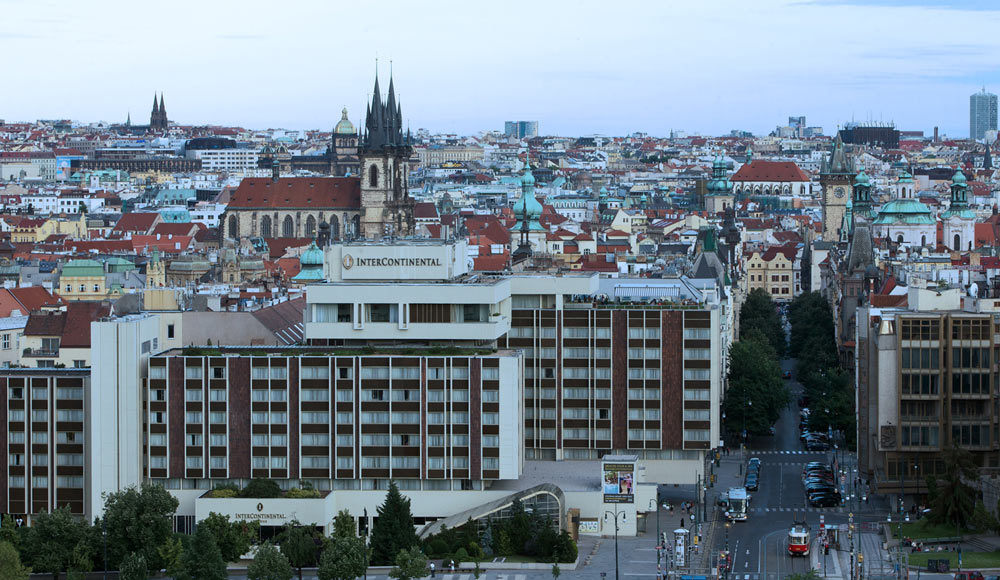
In its place now stands Hotel Inter-Continental, an excellent example of Brutalist architecture – which tends to be more admired and appreciated by architects than by the wider public. The hotel’s inspiration can be traced to Swiss-French architect Le Corbusier, who used a lot of béton brut (raw concrete), from which the name brutalism is derived. The hotel sprouted up around the same time as Prague Ruzyně International Airport. It is the work of Karel Filsak, Karel Bubeníček and Jaroslav Švec (1959–1968). Hotel Inter-Continental is carefully set in the historical center, offering breathtaking views to its guests day and night. At the same time, it is not diminishing the view of the Teachers’ Housing to the south in Elišky Krásnohorské street.
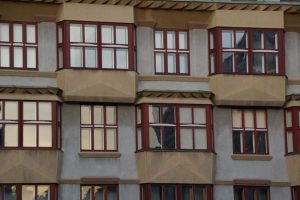 The cubist building called Teachers’ Housing is the work of Michal Novotný (1919–1921), who succeeded Jan Kotěra as the head of the Academy of Fine Arts. Our imagination is challenged as we try to shift perspectives; the cubist buildings are broken up into their simplest form and constituent element, which is the cube. It is our task to reconstruct these parts anew and sense the hidden dimensions that are lurking behind the customary ones.
With this shift in perspective, we continue our wanderings while we remain standing at Hotel Inter-Continental and venture toward deconstructing the past. The place for the hotel was created during the great sanitation (1882–1914), a grand project that wiped away the Abbey of Cyriacs and also much of Prague’s legendary Jewish Ghetto. Together with the Fifth Quarter of Prague, about 600 older buildings were demolished, including the Royal Palace in the place of the Municipal House. The Abbey of Cyriacs had been closed, together with many other monasteries, as an unwelcome side effect of the enlightened reforms of Joseph II (1784); and what remained was thoroughly washed away during the sanitation project. The square created in its place bore the name of John of Nepomuk, and not without reason. This is the place where the currents of Vltava decided to give out their secret. The secret was the story of a torture and of a death, which has been echoed in the following centuries, giving voice to hope and legends.
It was at the location of Hotel Inter-Continental that the Cyriacs, led by the five twinkling stars, found the body of the vicar general, John of Nepomuk (c. 1345–20 March, 1393). He had been caught up in the conflict between the Archbishop John of Jenśtejn and the King of Czech lands, Wenceslas IV. This happened during one of the city’s most turbulent times, the dawn of the Czech Reformation. John of Nepomuk was killed by torture, but his spirit was not broken and his integrity survived. The monks discovered his body and buried him in their courtyard. The anthropologist Vlček studied the mortal remains and the live tissue that was miraculously preserved and was believed to be the martyr’s incorruptible tongue. It was examined with great care and attention to detail, and so was the historical background of the story. All the results are gripping and fascinating to read.
But instead of reading, off we go. Our task is to find the place where the only remaining artifact of the washed-away monastery of the Cyriacs can be found. It is in the tiny courtyard of the Church of the Holy Spirit on Dušní Street, which we can reach after a short walk along Elišky Krásnohorské street. In Ferdinand Maximilian Brokoff’s sculptural group, John of Nepomuk is an alms-giver, standing facing the Spanish Synagogue. Interestingly, this patron saint of the Czech lands, who was canonized in 1721, is depicted without his typical attribute – the halo of five stars. His other attributes are palm branches (or water weed) and the cross.
Despite the short distance, the walk has led us away from under the baton of the giant metronome, away from the clear-cut and straight-lined streets that were created during the great sanitation. The final part of this walk invites us to get lost in the more hectic and swirling streets of the Old Town. We can visit the places where John of Nepomuk had worked: the churches of St. Giles and St. Havel.
This is no longer part of the guided walk. It is a walk outside of linear time; it is our personal search for the twinkling stars. In this constant time of relentless search, we are greeted by the solemnly playful apostles who preside over the Orloj (the Astronomical Clock) – the same apostles into whom Sucharda first breathed life. This walk invites us once again to take part in the fullness of time.


