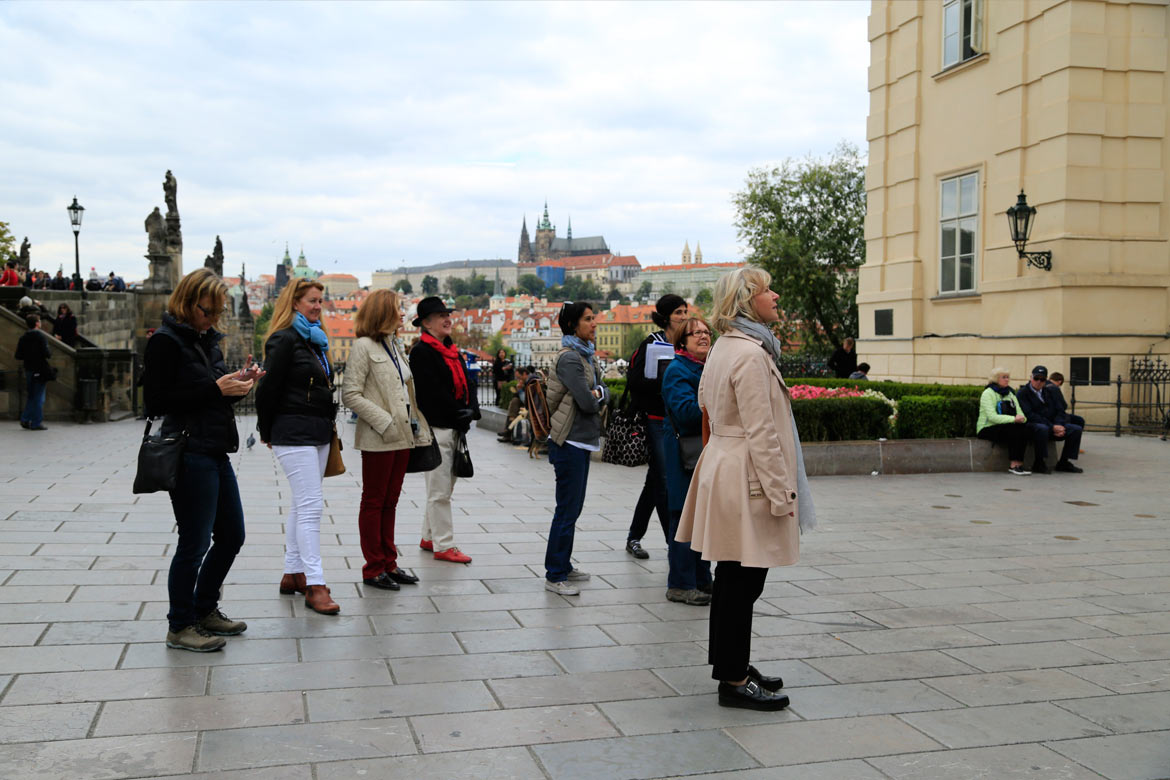

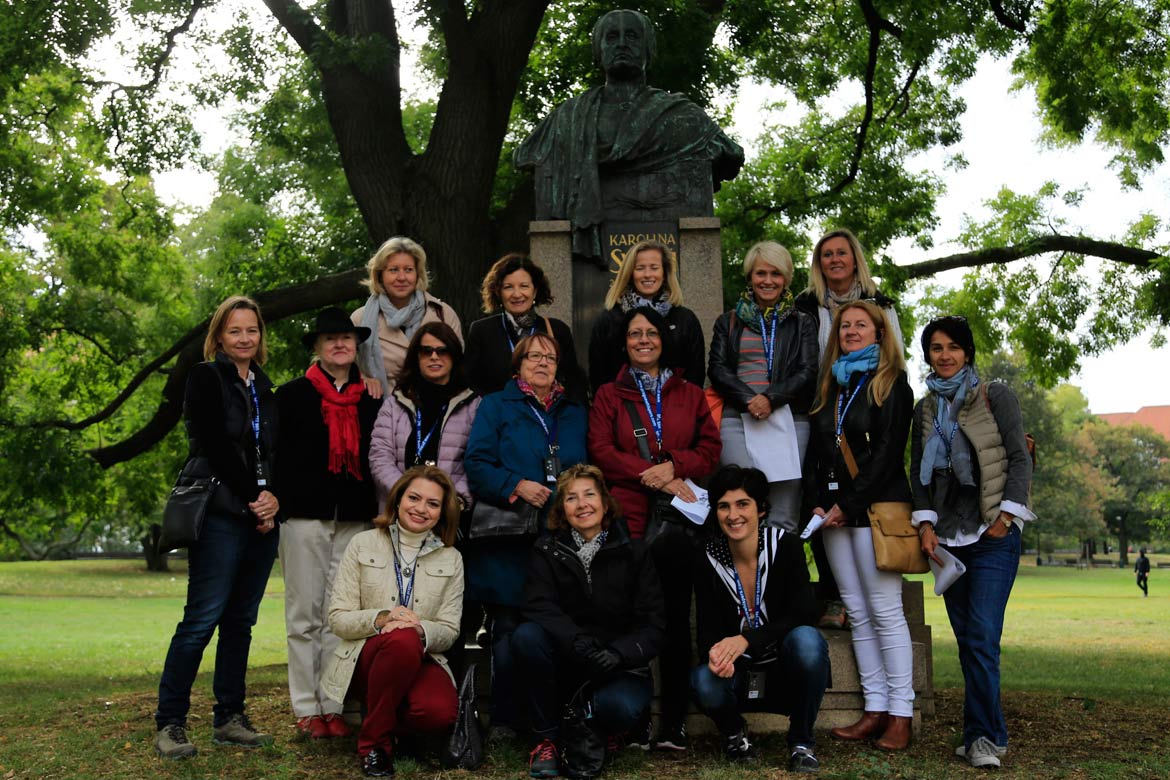
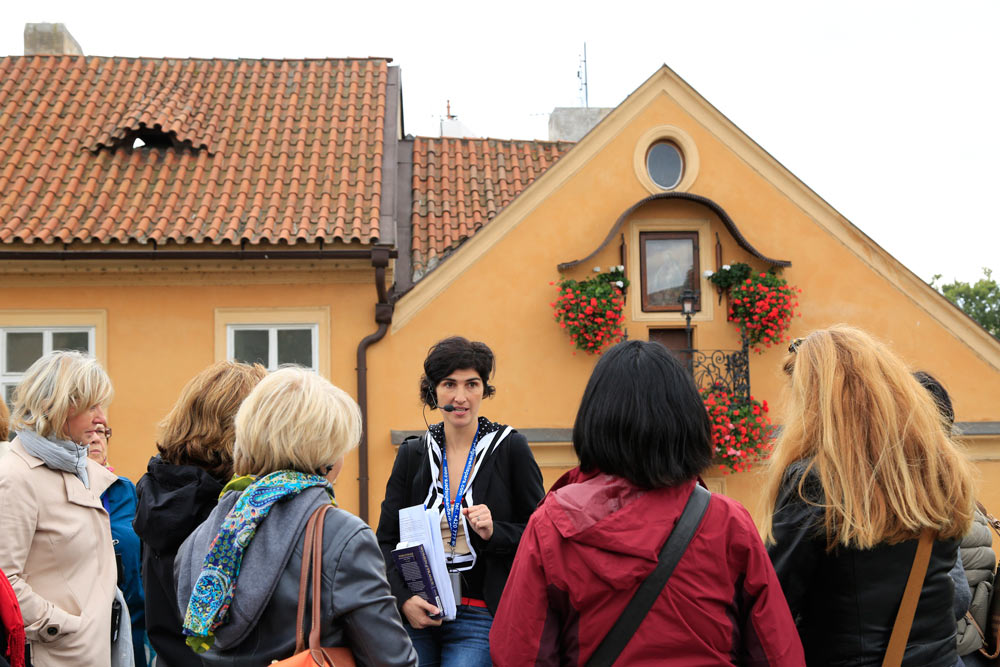
In recent years, a group of IWAP ladies took part in a walking tour which gave us some incredible facts regarding ‘famous women of Prague’. This tour highlighted stories behind invisible women we walk by everyday with little knowledge or regard. You know when you see a bust on a wall with a name underneath and you just glance by? These women were brought to life as we heard some fascinating things about women of the past, who walked these very streets in Prague.
We met at Karlovo náměstí, next to the statue of Karolina Světlá. She is the author of the famous Czech story “The Village.” Karolina was not encouraged at school despite being gifted, her teacher approached her parents saying if she were a boy, she would be a genius but it would not be healthy for a girl to have such stimulation.
Karolina was forbidden to learn languages, literature or mathematics; instead she was encouraged to prepare for ‘her duties’ as a woman. However, destiny can be a cruel mistress and she would have a wicked twist when her first and only child died at three months. The depression that followed was harsh and resulted in her physician suggesting she stimulate her brain, which is when she took up writing. There is so much more to this woman and what she accomplished for the betterment of other women in her time – it is well worth a Google search.
Our guide told us about other interesting women; for example Wencesles’ Mother, St Ludmila, who was killed by her daughter-in-law in a holy power struggle. It is told that she was strangled with a scarf so that no blood was spilt; all the statues of Ludmila have her wearing a scarf.
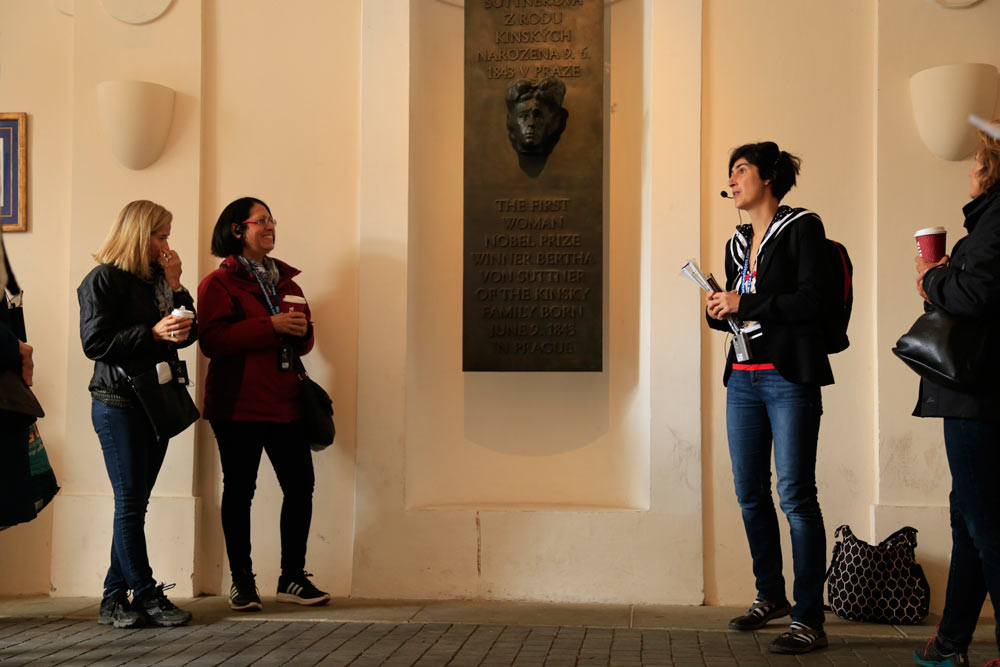
Bertha von Suttner was the first woman to receive a Nobel Peace Prize. Born to the Kinský family in Prague, she later moved to Vienna to work for Alfred Nobel. She can be found on the 2€ coin in Austria and is considered as one of the first intellectual Pacifists.
The woman on the Czech 500 CZK note is Božena Němcová, a writer in the final phase of the Czech National Movement who sought to write novels in the Czech language and not the formal language of German. She had a very interesting life and though she died poor, she had the kind of funeral reserved for royalty. 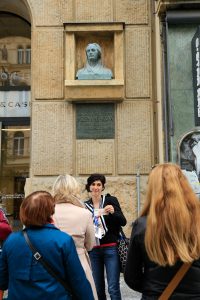
Milada Horáková studied law and set up resistance against the Nazis. She was imprisoned at Terezín, the prison camp for Jews from Czechoslovakia. To learn more about her life, a feature film – Milada – about the life of Milada Horáková was released in November 2017.
Milena Jesenská, studied at the Minerva school, which was the first school for girls in the Austro-Hungarian empire in Prague that actually taught rewarding courses, not just sewing and ironing. Milena’s husband was not earning much money, so she decided to supplement the family income with some translation work. Most books were still being written in formal German at this time. She worked on a short story translating it from German to Czech by a little known author called Franz Kafka. They had a romantic relationship for a while, but Milena would not leave her husband. This was the first translation of Kafka’s work.
The tour concluded with Madeleine Albright. Her family was originally from Smíchov. Her father was a diplomat, and during the Nazi occupation the family moved to England. Madeleine also appeared in a propaganda film about refugee children.
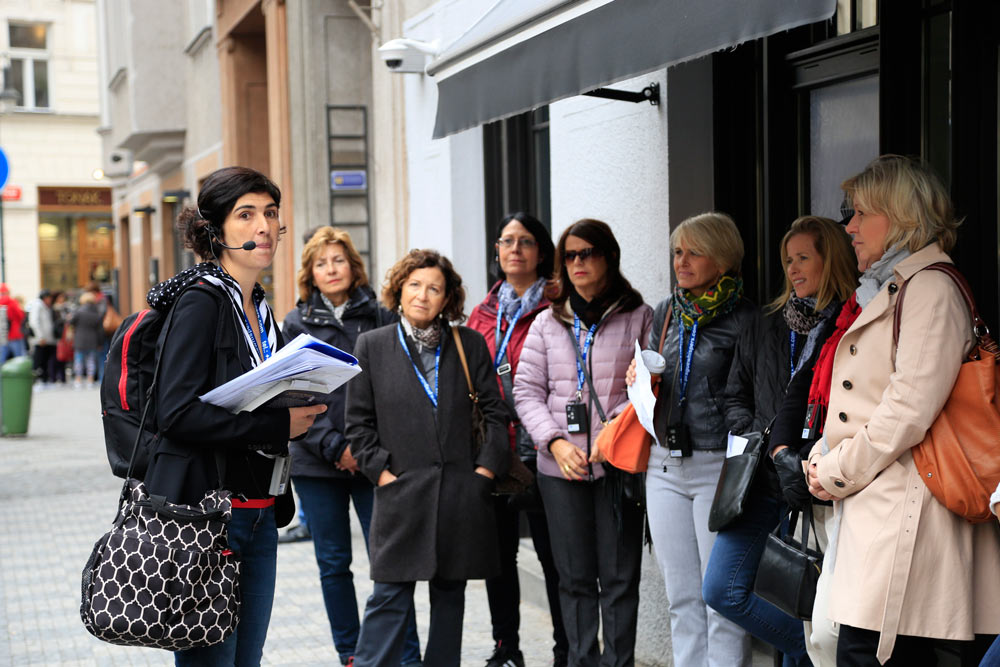
After the war the family moved back to Prague. The Communist way of life made things difficult so the family moved to the USA in 1948. It was not until Madeleine became known politically that people started researching her heritage.
She had been Catholic, then married an Episcopalian and converted to his faith. Only later did she find out that her parents were Jews and three of her grandparents had been murdered during the Holocaust.
When asked “what she is?” – her reply was that there are many things that make up Madeleine Albright, she is of Czechoslovakian Jewish heritage, a Catholic, a Wife, Mother, Grandmother, Politician and all these things go into making her who she is. A memorable Albright quote is “There is a special place in hell for women who do not help other women.”
It really is quite remarkable to consider all of these amazing women I have mentioned have walked around these beautiful streets of Prague, and that we may be walking in their very same footsteps.