
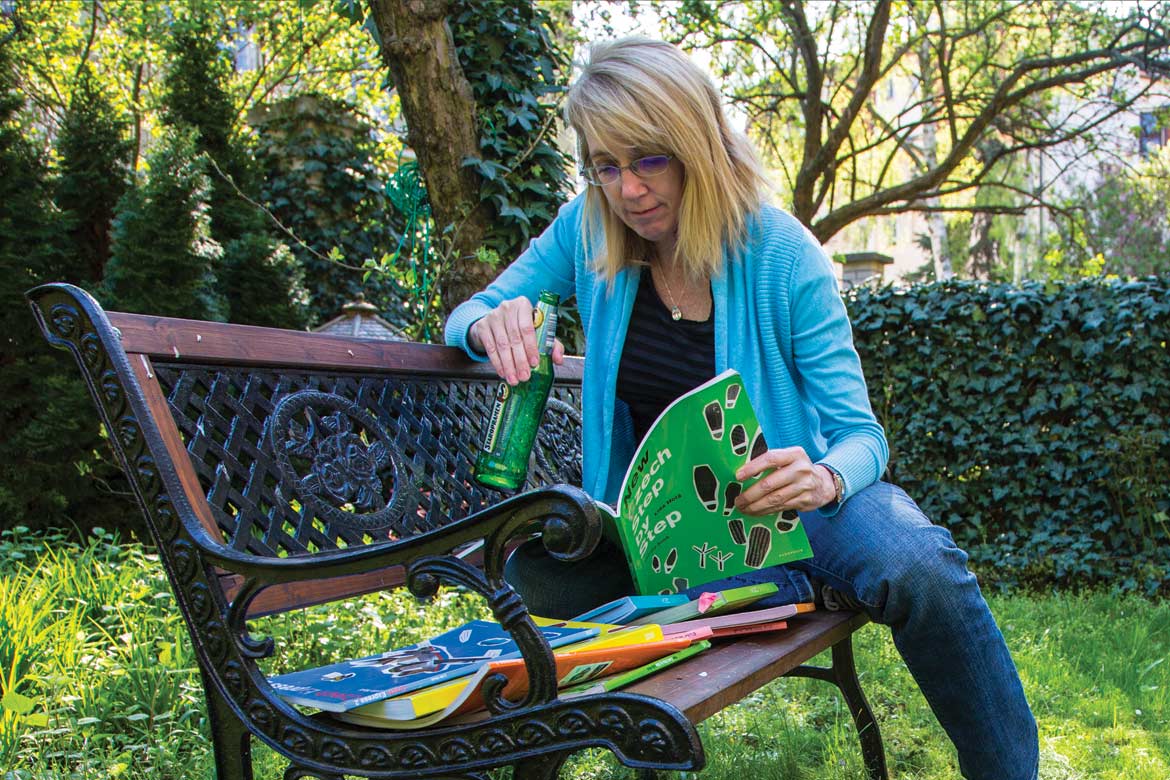
Among the many howlers I have committed in my struggle to learn Czech, the funniest has to be the time I called a cab driver “pani” (ma’am). I was so embarrassed that I couldn’t say anything until he dropped me off – ironically at the visa office (I was not making a good case for my residency here with my goof) – at which point I apologized and told him I knew he was “pan,” not “pani.” He said, very kindly, that he thought Czech must be a difficult language for foreigners to learn. I share this story not only to win sympathy, but also to show the rewards of wrestling with the language. When we try to speak their language, Czech people are in my experience universally kind, encouraging, and understanding.
But, given that not all of us are language mavens, how do we – whether beginners or students on hiatus – face the challenge of learning Czech? I asked three Czech teachers for their help. Broňa Prušaková wanted to become a language teacher because she “has personal experience with living abroad where [she] missed knowing the language.” Broňa teaches individuals at all levels as well as groups of up to eight. She has successfully prepared many students for the Czech exam. Šárka Doehring has a master’s degree in economics as well as coursework in pedagogy and pedagogical psychology. She has worked at the International School of Prague as both an aide and a Czech teacher, and she currently teaches individuals and groups of all levels. Jana Rodrová holds an advanced degree in education and teaches Czech courses at universities and schools and privately to people from several countries. I know from personal experience that Jana teaches all ages and levels, because she taught our whole family, from my kids and me, who were absolute beginners, to my husband, who, fluent in Russian, came here already speaking quite good Czech. All three teachers have helpful advice for Czech learners, no matter what our experience or level.
The teachers agreed that Czech is a challenging language to learn (and Šárka specifically mentioned my own nemesis, the genitive case), but they also agreed that it is important for us to focus on practicing and doing our best, because when we think about the difficulty, we can create obstacles for ourselves. Broňa advises that we “accept that Czech is a different language … We have those seven cases and a lot of prefixes and suffixes, … so it is good to take it easy and not worry.” Jana thinks that learning Czech varies greatly with the individual, and that it helps a lot to listen to people “in stores, on the street, at the post office, and in your neighborhood.” A particular advantage of practicing with our neighbors is that we make friends. For example, at our local grocery store, one of the clerks (who actually speaks English) gets a kick out my efforts to learn his language and always has little conversations with me in Czech.
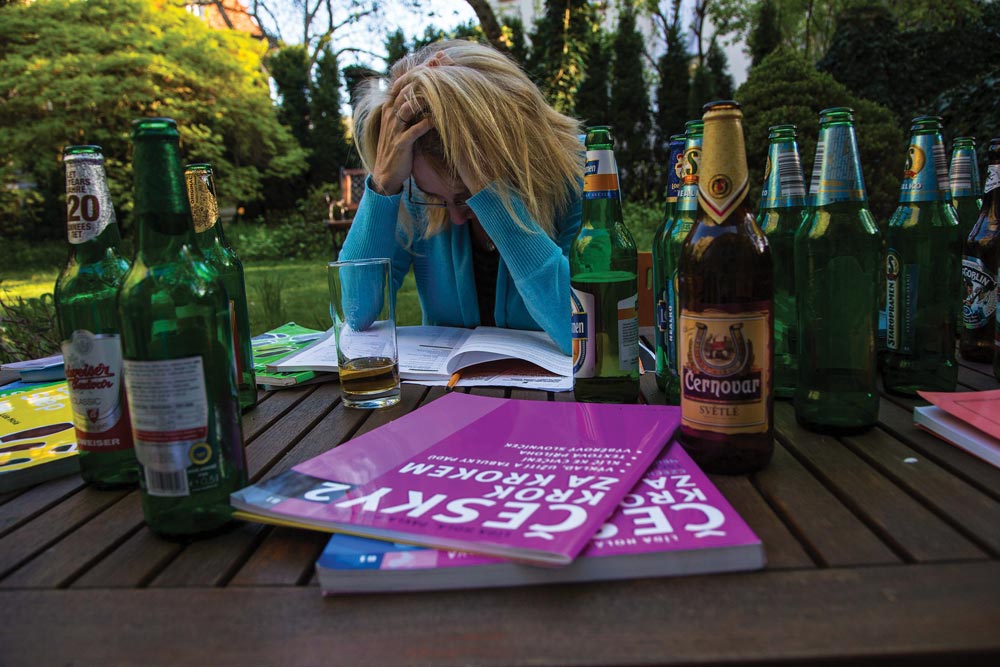
I started out by asking the teachers what they thought beginners should work on first. Jana responded poetically: “Open your soul, head, and ears, listen and read everything around you, and mainly repeat everything a lot!” Broňa and Šárka suggested learning some words and phrases before progressing to grammar. All three teachers reinforced my impression that Czechs will encourage beginners, even when we make mistakes. Broňa emphasized that “it is important to give up the wish that you will be perfect from the very beginning,” and Šárka added that “it is usually easy to figure out what you wanted to say and mistakes often sound very cute!”
I then turned to the challenges for students in my own position – people who take lessons for a while and then stop, perhaps because we get busy, lose interest, run into challenges with the language, or because our lesson package runs out. First, a little reassurance from Broňa: “If you find it is too difficult, do not press yourself. … The only way to find the motivation to learn is to be true to yourself. … A few new words can open doors or hearts to Czech people and make you feel better and safer in this country.” And, if we do decide to continue, Šárka’s and Jana’s tips sound like a lot of fun. “Talk to your kids if they take Czech at school. Learn to sing a song in Czech. …Continue in learning with topics you enjoy – culture, sports, dining, travelling,” says Šárka. Jana adds, “use Czech at work, read Czech news, … watch Czech films (at first maybe with subtitles), but mainly have Czech friends and colleagues and speak with them.” My husband created his own Czech film festival, first with English subtitles and then with Czech subtitles (so he could practice reading); he now watches films in Czech with no subtitles. And I have found that music is an excellent way to appreciate Czech language and culture. I recently performed two Czech folk songs at a recital and enjoyed the contrast between their poignant music and their down-to-earth words. One song, “Koulelo se koulelo,” whose melancholy tune makes it sound tragic, is in fact a young man’s effort to proposition a girl he’s picking apples with. It ends with the suggestion, “You are pretty, so am I. / We go well together.” The song not only helped me improve my vocabulary but also gave me insight into the Czech sense of humor.
When I asked the teachers for funny stories about learning Czech, I was gratified to discover that I was not alone in making silly mistakes. Broňa told me about a woman who wanted to get an Opencard for her 17-year-old daughter and told the clerk that her daughter was 700 years old. [This story reminded me of the time I told a waiter to round the bill up to 12,000 crowns instead of 1200; fortunately, he told me about my mistake rather than just taking the money.] It can be difficult to get the tone right in another language, too. Šárka had a student from the U.S. who, when stopped by a policeman, said, “Ahoj. Jak se máš?” Šárka worried that the policeman would be angry at this informal way of speaking, but “he smiled and appreciated that she tried in Czech.” And Jana generously offered a story about her own mistake: “I was learning Spanish and went on a trip with my family to Madrid. No one except me knew Spanish, and the Spaniards didn’t speak much English, so I had to translate. One time there was no ashtray on the table at a restaurant, and my friends who smoke needed it. I asked the waiter whether he could bring it. The waiter looked at me strangely, but left. Then he returned with the chef and said, ‘Here he is!’ … [The Spanish words for chef and ashtray are similar.] I made a mistake … and to this day I remember those two words well.” So mistakes happen to us all – students as well as teachers. The more mistakes we make, the more we learn, and the more funny stories we have to tell. So, as we continue to learn, hodně štěstí to us all!


