


These days it would be impossible not to encounter the word “robot” more and more frequently during one’s daily life. Robots, mechanical devices that perform routine tasks on command and thus replace the human effort, have become not only essential to industry, manufacture, warehousing, deliveries and in science and technology in general. They are deployed in education, culture and have also slowly entered our homes as inseparable helpers with unwanted routine tasks.
And the progress does not stop there of course; once the work is done we want and expect more. So here comes the ongoing research into the development of human-like creatures who will act as providers of emotional support and source of happiness. The robotic assistant Alexa is now part of many people’s lives and the walking, talking, even thinking robots are beginning to enter our society. The humanoid robot Sophia has celebrated her fourth birthday this year.
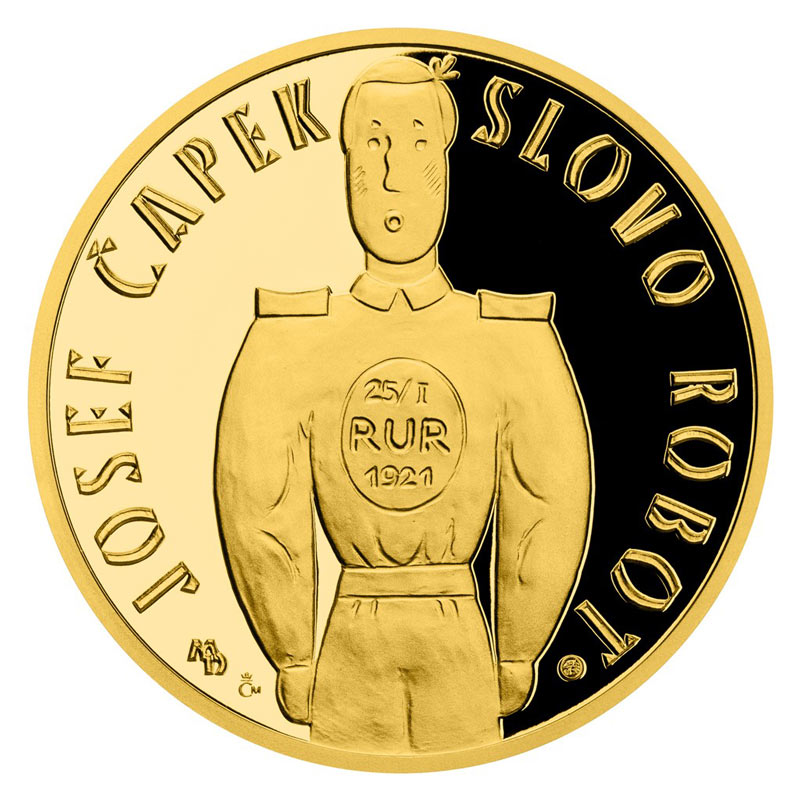 But in 2020 we celebrate one much grander anniversary than that. This September marks one hundred years since the birth of the word “robot” itself. That the word is this old might surprise some, but its origins go further than that. The noun “robota” means “forced labour” in the Czech language and the shortened “robot”, based on it, was first coined in the play Rossum’s Universal Robots by the Czech writer Karel Čapek, written in 1920.
This visionary work of science fiction, translated and staged in many other languages abroad, brought the thirty years old writer worldwide acclaim and introduced this neologism into many world languages – and so it seems appropriate that the IWAP Friday Book Club started off our reading year with this selection.
Although it was Karel Čapek who wrote the play, known under its shorter version R. U. R., it was not actually him who came up with the famous name for the humanoids, but his brother, painter and graphic artist, Josef Čapek. Both brothers lived in Prague and shared a large 1st floor apartment in Říční Street no. 11, a quiet street by the river Vltava off the Kampa park in the Lesser Quarter (there is a bronze plaque beneath the 1st floor windows commemorating their living and working here from 1907 to 1925).
The story about the name robot goes like this. One day Karel suddenly came to Josef’s atelier pleased to tell his brother about his latest idea for a play about artificial workers but discontented because he could not think of a suitable name for them. He toyed with “labouri” from the Latin for work but did not like it. Without taking a brush from his mouth Josef said “why not call them robots”? That struck the right chord and stayed.
Karel Čapek wrote the R. U. R. in a week and it was published in November 1920 in 2000 copies as a paperback with one of Josef Čapek simple book cover designs in linocut that were to become characteristic of the 1920s paperback covers of the Prague publisher Aventinum.
The stage presentation of the R. U. R. in the National Theatre in Prague took place at the end of January 1921 with the costumes designed by Josef Čapek. It was a great success. The play was staged in New York a year later, London production was performed in 1923, Paris 1924 etc. They brought Čapek world acclaim and beside the Macropulos case, made famous through Leoš Janáček’s music setting as an opera, the R. U. R. remains to be Karel Čapek’s best known drama, alas not as widely performed now as it deserves.

Karel Čapek was of course not the first to bring into literature artificial creatures that act as human beings. English literature had Frankenstein and Prague itself had the legends of the clay Golem created by Maharal. Čapek himself said that the Robot is a Golem in a modern form. What brought him then to devoting a play to a subject of creating and living with automatons?
In 1920 the world was still recovering from the shock and consequences of World War I when technological and chemical advancements, utilized in military warfare, caused an unprecedented carnage. Karel Čapek was concerned about the possibilities of the misuse and abuse of scientific and technological progress and worried about its tendency to develop faster than human morality. Can ethics keep pace with the fast growing innovations and their impact on society? What will be the consequences of our interference with the natural world? What will follow when machine intelligence surpasses human intelligence? These are the ideas and questions Čapek poses in his drama about Robots, robotics and even roboticists.
It is a collective drama without any attempts at elaborate psychology of main protagonists. The characters represent certain life attitudes, beliefs or values, according to which they act, and the story is simple. It takes place in a factory for the manufacture of Robots – artificial beings in appearance almost unrecognizable from humans but, unlike humans, devoid of any ability to feel. They cannot feel any pain or pleasure and are not able to reproduce themselves. They are made by humans to provide cheap labour so that humankind can have more leisure time, concentrate on improving themselves, or get richer through cheaper production provided by the Robots. But matters get out of hand – the birthrate of humans recedes to zero.
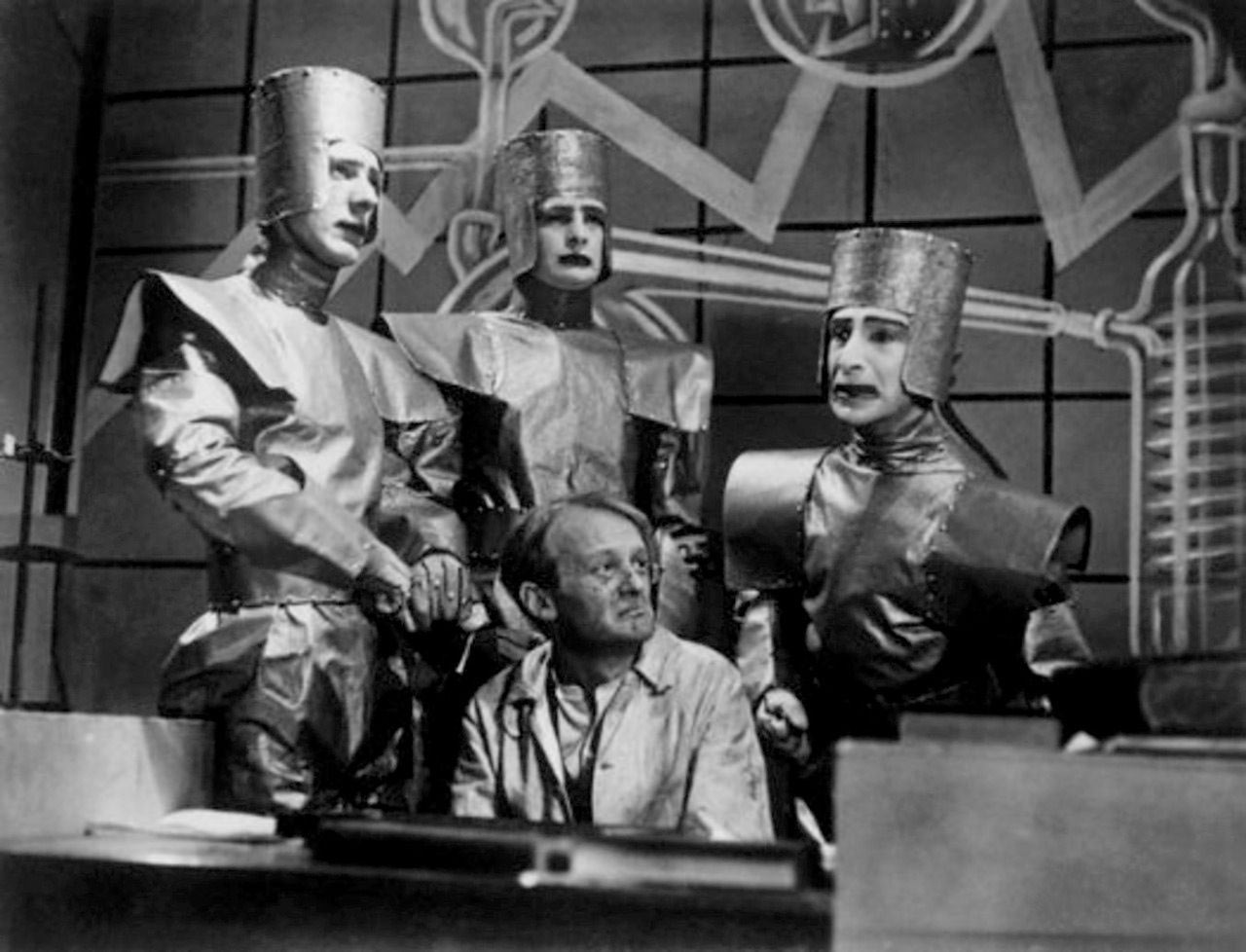
Robots begin to outnumber people who make them and start looking at humans as inferior to themselves. The lady who at first comes to check on fair treatment of the Robots and promotes their emancipation, ends up as their prisoner together with the rest of the factory staff. Robots take over the control of the factory, fighting ensues and eventually only one person is kept alive. The Robots believe that he is the one who will teach them how to multiply. This is not in his power but he notices that two of the Robots are beginning to fall in love and can therefore get closer in their makeup to their creators after all. Could this be the new Adam and Eve?
Although his play is a warning against the blind use and misuse of scientific and technological advancements that could lead to eventual enslavement of humankind by them, Čapek ends his drama on an optimistic note believing in the natural power of love.
Note: The right picture in the header above is the set design by Bedřich Feuerstein for the R.U.R. production in the National theatre in Prague, 1921.


